
Team:
Laura Tosatto
Collaborators:
Manuela Basso (UniTrento), Maria Pennuto (Unipd), Xavier Salvatella (IRB, Barcellona), Mathew H. Horrocks (EaStHEM, Edinburgh), Francesca Coscia (Human Techopole), Carlotta Tacconi (IFC, CNR), Giorgio Arrigoni (Unipd), Sara Pellegrino (UniMi)
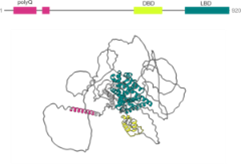
Androgen receptor (AR) is the transcription factor mediating the effects of testosterone at genetic level. It is responsible for the development of male sexual characteristics as well as muscle mass, hair and male skeletalmaintenance. It is organized with a large disordered N-terminal domain (NtD), a well-structured DNA-binding domain (DBD) and a conserved Ligand Binding Domain (LBD). AR is linked to several pathologicalcondition: the loss of function of the protein in related to androgens insensitivity syndrome, the gain of function of AR is linked to prostate cancer, and an extension of a poly-Glutamine stretch in the NtD is related to a neuro muscular degenerative disease called Spinal and Bulbar Muscular Atrophy (SBMA).
The NtD of AR is site for several post-translational modifications. In particular, phosphorylation is able to tune, abolish or boost the activity of AR and it is also dysregulated in pathologies like cancer and SBMA. The project aims to characterize the effects of phosphorylation on AR at molecular level, using integrated structural, cell biology and omics approaches. The long terms objectives aim to contribute to the knowledge of AR basic biology and ways to find therapeutic strategies for AR linked diseases.